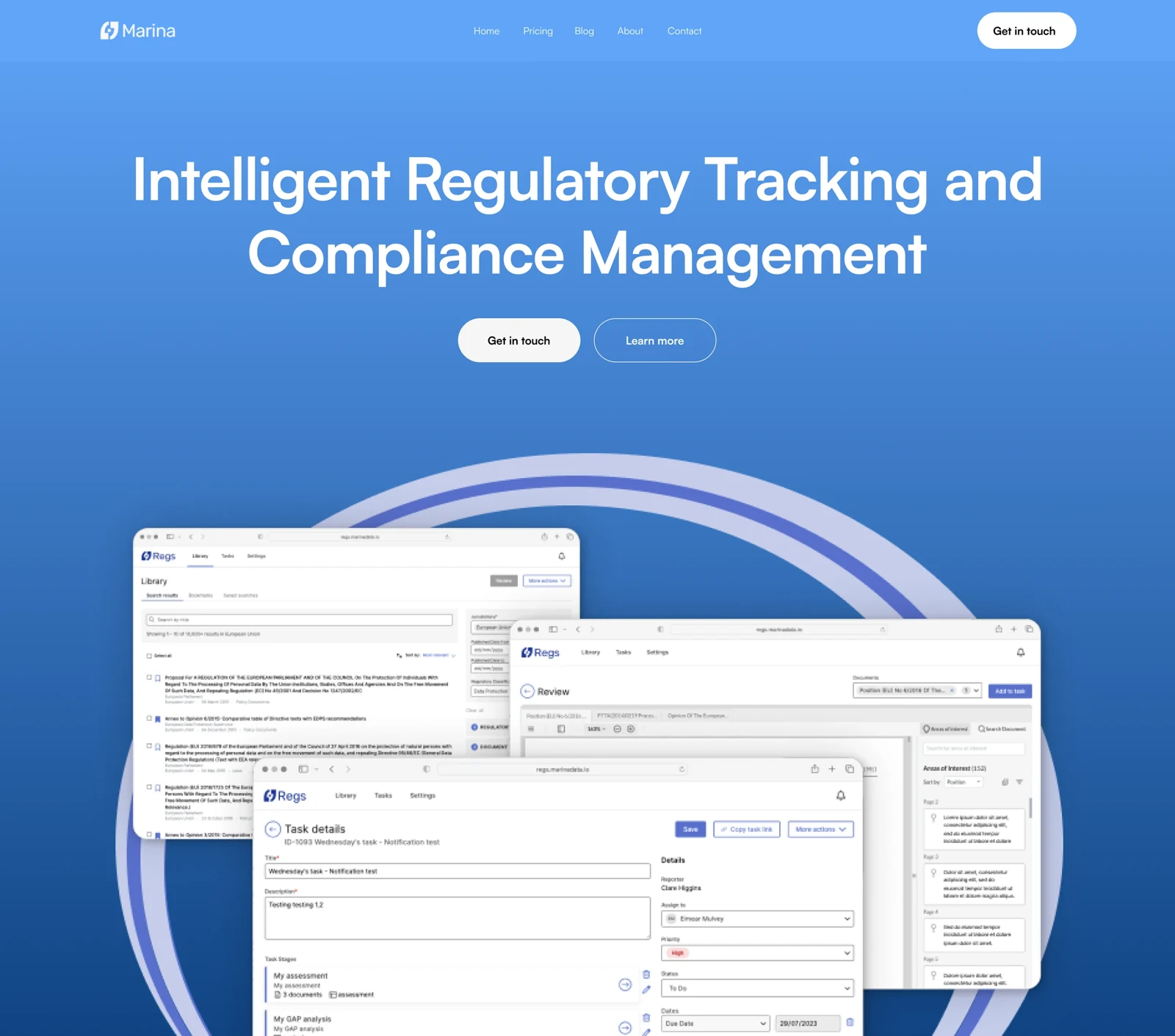
AI for compliance & document review
Marina Data
Clearer obligations.
Accountable decisions.
Marina helps compliance teams interpret regulatory change, connect obligations to controls and prepare action for review. Its document intelligence also supported pet-claims validation, where assessors checked source-linked evidence and retained the final decision.

- The challenge
- Turn complex requirements and records into evidence that teams can review, act on and explain.
- My role
- At Shipyard Technology Ventures as Director and Executive Committee Member, I connected enterprise review requirements with Marina’s product team, engineering colleagues and claims assessors.
- What changed
- Compliance workflows connect obligations, controls and action. The separate pet-claims workflow reported 125× faster pre-existing-condition validation, with assessors retaining the decision.
Review responsibility
Compliance use cases
From regulatory change
to reviewed action.
New rules, revised policies and evidence spread across documents make it difficult to see what needs attention. Marina brings that work into a sequence of reviewable obligations, actions and reporting.
How the platform works
One workflow, from input to oversight.
Gather & organise
Bring regulatory updates, policies and evidence into a consistent record. Identify jurisdictions, dates and affected requirements.
Link & evaluate
Relate obligations to policies and controls so teams can review applicability and the areas affected.
Prepare & assign
Draft responses and remediation tasks, keeping sign-off with the people responsible for the work.
Track & report
Monitor actions and assemble dashboards and reports for oversight and audit preparation.
Adapted from Marina Data’s published compliance workflow .
Where it helps
Six compliance workflows.
Regulatory change monitoring
Collect updates, compare versions and identify new obligations across jurisdictions.
OutputA classified change record.
Obligation and control mapping
Connect requirements to relevant policies, controls, processes and teams.
OutputAn applicability and impact review.
Compliance gap review
Surface missing controls, conflicting documents and evidence that needs attention.
OutputGaps prioritised for review.
Explore three more compliance workflowsDrafting, remediation and audit preparation
RFI and policy drafting
Prepare questionnaire answers and policy amendments using existing evidence.
OutputDrafts for human approval.
Remediation and ownership
Turn identified gaps into tasks with owners, deadlines and progress tracking.
OutputA coordinated action plan.
Audit preparation and reporting
Bring obligations, decisions, actions and supporting documents into structured reports.
OutputTraceable material for audit review.
Across regulated operations
- Financial institutions
- Regulatory obligations across markets.
- Card issuers and acquirers
- Card-network rule changes and business impact.
- Franchisers and members
- Operational standards across locations.
Compliance platform engineering
Marina’s published engineering roles describe ingestion services, entity models and integrations feeding dashboards and workflow interfaces. AI engineering focuses on ingesting, mapping and explaining compliance obligations, supported by deployment automation, monitoring and tests for AI-assisted logic.
The platform connects document preparation and control mapping to proposed actions and human sign-off. This technical overview concerns the compliance platform; the historical pet-claims example below remains separate.
AI-assisted document review
Pet claims: a focused validation workflow.
In pet insurance, Marina prepared evidence for pre-existing-condition checks. The assessor retained responsibility for the claim decision.
Before · Manual review
Years of records. One claim.
- Review veterinary notes, invoices and handwritten forms for each dog.
- Check for pre-existing conditions before the claim can be paid.
- Check breed-specific conditions and exclusions.
- Manual review creates a backlog and slows payouts.
Reported result
125×
faster pre-existing-condition validation than the manual process
After · AI-assisted review
Evidence ready for the assessor.
- Input
- Veterinary records, invoices, handwritten notes and the insurer’s condition taxonomy.
- AI preparation
- Extract conditions and dates, check the breed and cross-reference the insurer’s taxonomy.
- Output
- Source-linked findings for pre-existing-condition validation.
- Human review
- An assessor checks the source-linked evidence and makes the claim decision.
The same focus on traceable evidence.
For compliance teams, Marina connected obligations to source documents, mapped controls and prepared evidence for review. The 125× result relates to pet claims validation.
AI reads the evidence. People own the decision.
What the 125× result measures
The project portfolio reports pre-existing-condition validation as 125× faster than the previous manual process. This is the evidence-preparation stage of the historical pet-claims workflow. The assessor retained responsibility for the claim decision.
The portfolio does not specify the sample size or measurement period. The result is specific to that validation workflow.
The decision
that mattered
Keep every finding connected to its source.
A reviewer needs to see what a finding means, where it came from and what action it calls for. That principle connects compliance review with the historical claims work.
I connected enterprise review requirements with the product and engineering teams and claims assessors. The workflow kept findings linked to source records and the insurer’s condition taxonomy.
What this made possibleAI prepares evidence and proposed action for people to review. Compliance teams approve the response to an obligation; claims assessors retain the decision on a claim.