Build for Ireland: A Successful Hackday Showing What Open Data and AI Can Make Possible
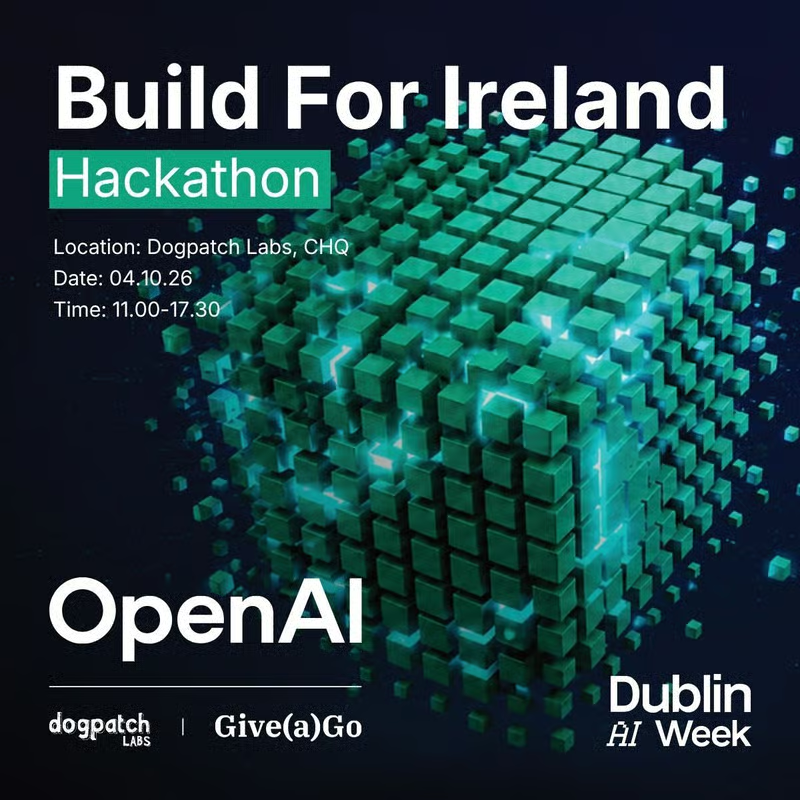
On Sunday, 4 October, Build for Ireland brought a community of builders together at Dogpatch Labs to tackle a simple challenge: use public data and AI to build something useful for Ireland.
Delivered by OpenAI, Give(a)Go and Dogpatch Labs as part of Dublin AI Week, the hackday demonstrated how quickly ideas can become prototypes when people have access to data, tools and collaborators. The organisers’ recap describes around 150 builders working on challenges across housing, transport, healthcare and accessibility. The published project gallery now lists 32 submissions.
That is a substantial result for a single day. It also gives us something concrete to explore: a collection of ideas, demonstrations and code showing how public information might help address everyday problems.
Turning public data into practical ideas
The range of projects is one of the strongest indicators of the day’s success.
Transport featured prominently. Ghost Bus Tracker’s submission lists live vehicle positions, journey updates and published timetables as its data sources. MissingLink explored transport improvement planning, while Honest Live Transport also drew on timetable and real-time feeds. Together, these projects show the appetite for making transport information more useful to the people who depend on it.
Housing and planning generated another strong cluster of ideas. RentCheck drew on published rent statistics, while Precedent used past planning applications, decisions and locations. Home Fit brought together information including childcare and school locations to help people consider where to live.
The gallery also includes InfraConnect, focused on bringing healthcare to rural communities, and GP Ops, described as helping turn hospital letters into action while keeping the GP in control.
Energy and resilience were represented too. WattWhen explored when to use, store and sell electricity, drawing on grid and weather information. Ready72 focused on preparedness for the first 72 hours of an emergency.
These were early prototypes, with further development and validation ahead of them. Their achievement was to make a practical idea tangible enough for others to examine, test and improve.
My contribution: understanding where open data can create value
My own submission, Open Data Impact, addressed a question that sits behind many of these projects: how do we identify the datasets with the greatest potential to support useful services, better decisions and innovation?
As a member of the Open Data Governance Board, I see a significant opportunity to help more people discover and use public data. Publishing a dataset is an essential first step. Understanding its quality, usefulness and potential for reuse helps us decide what to do next.
I developed a transparent scoring framework using ChatGPT, covering eight criteria: data quality; public value; strategic alignment; usage and reach; economic and innovation potential; operational value; demonstrated impact; and risk and ethics.
Using Codex, I applied the framework across 22,608 datasets in Ireland’s national open-data catalogue, producing a comparable Open Data Impact Score for each.
The prototype is intended to help identify promising datasets, highlight gaps in metadata or supporting evidence, and surface opportunities for reuse. Those scores are a starting point for investigation and validation. Evidence of actual impact still needs to come from the people and organisations using the data.
The longer-term ambition is to develop a European Open Data Intelligence Layer with partners across government, creating a shared approach to understanding the quality, impact and potential value of public data.
Keeping the momentum going
For me, the most encouraging outcome of Build for Ireland is the opportunity it creates for continued collaboration.
Public bodies can bring problem knowledge and an understanding of their datasets. Builders can bring fresh perspectives and the ability to test ideas quickly. Researchers, startups and established businesses can help develop and evaluate the most promising approaches.
A useful next step would be to connect interested teams with relevant data owners and potential users, then support a small number of focused pilots. Each pilot should have a clear problem, a practical route to testing and a measurable outcome, whether that is time saved, better access to information or a more useful public service.
Congratulations to everyone who built, collaborated and shared their work, and thank you to OpenAI, Give(a)Go and Dogpatch Labs for making the day possible.
Build for Ireland has given us 32 projects to explore and a community with the ability to keep building. I would love to see that energy carried forward into services and businesses that create lasting value for Ireland.