From Open Data to Real-World Impact: What Can We Build for Ireland?
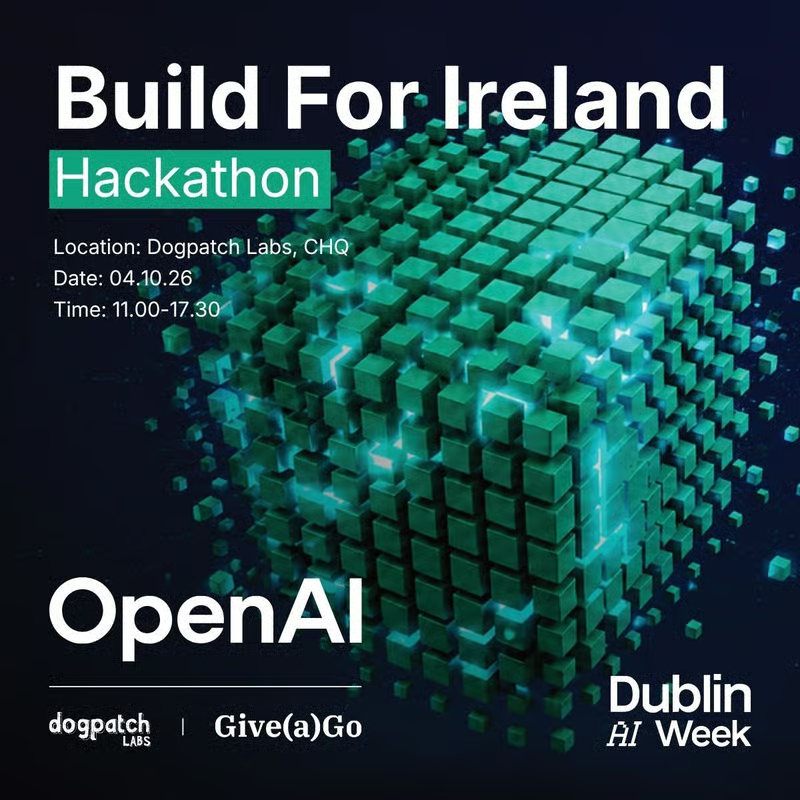
On Sunday, 4 October, around 150–200 engineers, founders, researchers, designers and builders will come together at Dogpatch Labs in Dublin for Build for Ireland, a one-day AI build event being delivered in partnership with OpenAI, Give(a)Go and Dogpatch Labs as part of Dublin AI Week.
The challenge is deliberately straightforward:
Find a real problem facing Ireland, use public data and build something useful.
From my perspective as a member of Ireland’s Open Data Governance Board, this is exactly the type of experimentation I believe we need to encourage.
Because publishing public data is important.
But publishing it is only the beginning.
We already have the raw material
Ireland has built a significant national Open Data resource.
Today, data.gov.ie provides access to more than 22,700 datasets from 143 public-sector publishers.
The data covers an enormous range of subjects: transport, mobility, housing, planning, the environment, energy, health, population, agriculture, education, local government, business, the economy and public administration.
There are also hundreds of datasets identified as High Value Datasets because of their potential economic, social and environmental value.
Many datasets can be downloaded directly, while others are available through APIs and machine-readable formats that can be incorporated directly into digital products.
For a developer, founder or researcher, that represents an extraordinary raw material.
But the really interesting question is not:
How many datasets do we have?
It is:
What can we build with them?
Publishing data is not the end goal
One of the important questions for any national Open Data programme is what happens after a dataset is published.
Does somebody use it to create a better public service?
Does a researcher discover something that changes how we understand a problem?
Can an entrepreneur turn it into a new product or company?
Can an existing business use it to make better decisions?
Can communities use it to understand what is happening around them?
Can several datasets be combined to reveal something that none of them could show individually?
And increasingly:
Can AI turn complex public data into something that an ordinary citizen or business can actually use?
Those are the outcomes that ultimately matter.
AI changes the economics of Open Data
Historically, extracting value from public data could be technically difficult.
First you had to discover the right dataset.
Then understand its structure.
Clean it.
Connect it to other sources.
Build the data pipelines.
Develop an application.
Design an interface.
Maintain the integrations.
For many potentially useful applications, the cost and complexity meant they simply never got built.
AI is changing that equation.
Large language models, AI agents, modern APIs and tools such as Codex are dramatically reducing the distance between having an idea and building a working product.
That has potentially profound implications for Open Data.
A transport dataset is no longer simply a spreadsheet, database or API.
Combined with weather, event and geographic information, it could form part of a service predicting disruption before somebody leaves home.
Planning, property and demographic data could be combined to help people understand how communities are changing.
Environmental, meteorological and geographic datasets could create entirely new tools for communities, businesses and researchers.
Public-service APIs could potentially be connected through AI agents, allowing someone to ask a question naturally rather than having to understand which government department owns which piece of information.
And there will inevitably be applications that those of us working in government, policy or data governance simply haven’t thought of.
That is why putting the data into the hands of builders matters.
Start with data.gov.ie — but don’t stop at one dataset
One suggestion I would make to anyone participating in Build for Ireland is to spend some time exploring data.gov.ie before the event.
But don’t necessarily search for one perfect dataset.
Look for connections.
Could transport information be combined with weather, road and event data?
Could housing, planning, infrastructure and population data reveal something about where future pressure on services might emerge?
Could environmental and geographic datasets create new tools for communities?
Could tourism, transport and local-business information create better visitor experiences?
Could economic and employment data help identify emerging regional opportunities?
Could an AI agent combine information from several public APIs so that a citizen or business can ask one question instead of searching through multiple public-sector websites?
Often the value is not in any individual dataset.
It is in what becomes possible when datasets are connected.
And AI makes those connections considerably easier to explore.
Open Data can be economic infrastructure
Open Data is rightly associated with transparency, accountability and better government.
Those objectives remain fundamental.
But I think we should also be ambitious about its potential as economic infrastructure.
Public data is an input into products.
It is an input into research.
It is an input into AI systems.
It can help existing businesses make better decisions.
And it can provide the foundations on which entirely new companies are created.
Transport data can underpin mobility businesses.
Geospatial information can underpin property and infrastructure products.
Weather and environmental data can support energy, agriculture and climate applications.
Planning and housing data can support property and construction technology.
Company, demographic and economic information can support financial and professional services.
Seen in that context, Open Data is not simply something government publishes.
It can become part of the infrastructure on which innovation happens.
We should measure impact, not simply publication
That also raises a broader question about how we measure the success of Open Data.
Dataset numbers matter.
Data quality matters.
Machine readability matters.
API availability matters.
Standards and interoperability matter.
But ultimately I think we need to go further.
We should increasingly ask:
How many products have been created using public data?
How many companies use it?
How many new businesses has it helped enable?
What research has it supported?
What public services have improved because of it?
How much time or money has it saved citizens and businesses?
What measurable economic, environmental or social outcomes have resulted?
In other words:
The next phase of Open Data in Ireland should not only be about publishing more data. It should be about making it easier for entrepreneurs, developers, researchers, businesses and citizens to turn that data into products, companies, research and better public services.
Build something, not just a presentation
One of the things I particularly like about the format of Build for Ireland is the emphasis on actually building.
Participants will have one day.
They will form teams, identify a problem, work with public data and use Codex and other OpenAI tools to develop something they can demonstrate.
OpenAI will provide credits to participants.
Eight teams will then be selected to demonstrate what they have built.
There is no formal judging panel or cash prize.
The objective is useful work, strong teams and projects that have the potential to continue after the event.
That matters.
Innovation does not always begin with a large programme or a lengthy strategy document.
Sometimes it begins by putting talented people in a room with an important problem, useful data and powerful technology — and asking them to build.
An opportunity for Ireland
Ireland is in an interesting position.
We have a substantial technology sector.
A strong startup and research ecosystem.
Significant AI capability.
A large and growing national Open Data resource.
And a public sector that generates enormous quantities of potentially valuable information.
Connecting those ingredients more deliberately could create significant value.
Events such as Build for Ireland are one way of testing what is possible.
They expose developers to datasets they may never previously have encountered.
They expose public bodies to entirely different ways their information might be used.
They bring technologists and public-policy challenges into the same room.
And, importantly, they create evidence.
Instead of talking theoretically about what people could build using Ireland’s public data, we get to see what they actually build.
So, what would you build?
Build for Ireland takes place at Dogpatch Labs in Dublin on Sunday, 4 October.
It is aimed at engineers, technical founders, researchers, designers and strong recent graduates who enjoy building and shipping.
The brief is intentionally broad.
Traffic.
Transport.
Infrastructure.
Housing.
Planning.
Environment.
Energy.
Local services.
Business.
Communities.
Or something completely different.
I would encourage anyone considering taking part to visit data.gov.ie, explore what is available and think about a problem worth solving.
Then ask:
What becomes possible when I combine this public data with AI?
Find a problem.
Find the data.
Connect the datasets.
Build something.
And show us what Ireland’s Open Data can become.
Build for Ireland:
https://luma.com/build-for-ireland