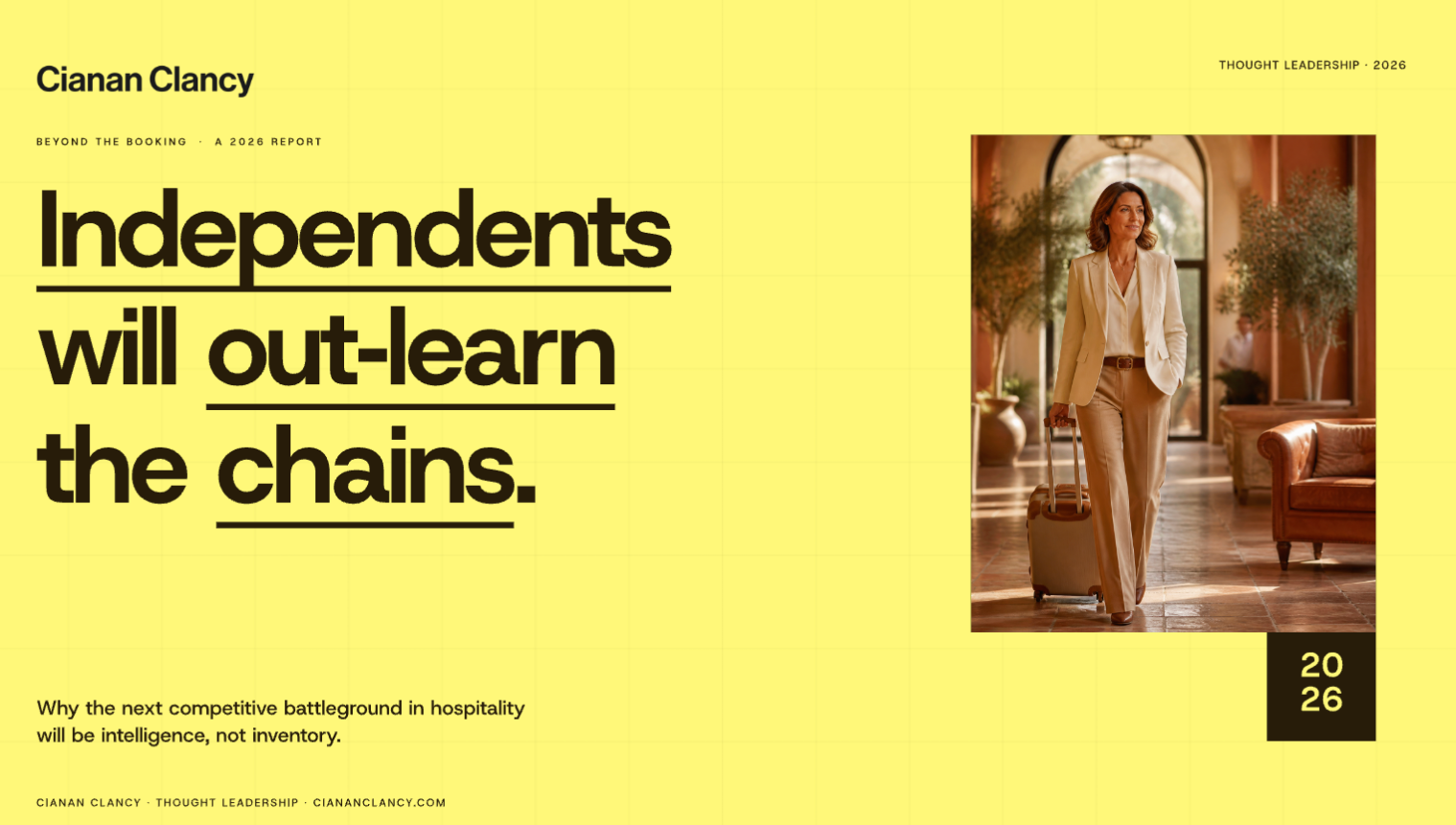
Why the next competitive battleground in hospitality will be intelligence, not inventory
For twenty years, hospitality technology has competed on functionality. More integrations. More channels. More dashboards. More reports. The property that could see itself most clearly, most often, in the most systems, would win.
That era is ending.
Not because the tools were wrong. They were the foundation. But the operators I speak to every week no longer describe their problem as a shortage of information. They describe the opposite. They have more data than any independent hotel has ever had access to. They have less time to make sense of it than any operator I can remember. The gap between what they can see and what they can act on has never been wider.
This piece makes one claim: the next decade of hospitality technology will not be won on inventory, but on intelligence. And the operators who move first — for the first time in the industry’s history — are not the ones with the deepest pockets.
The signals are already telling us
Cloudbeds’ 2026 State of Independent Lodging report tells a clear story. Global ADR and RevPAR are flat. Independents across every region — North America down 3.1% on RevPAR, EMEA down 3.9%, Asia Pacific down 17.5% — are running harder to stand still. Booking windows have lengthened to 40 days on average. Cancellation windows to 38.7. Every extra day in that window is a decision the operator now has to make earlier, with less certainty, in a market that keeps shifting under them.
At the same time, 63.4% of independent bookings now come through online travel agencies. In several markets — Portugal, Indonesia, Spain — that share exceeds 76%. And crucially: OTA cancellations run at 21.8%, compared to 10.6% for direct bookings. Distribution is no longer just a margin question. It is a forecast-reliability question, a staffing question, a revenue-management question, all at once.
None of this is a shortage of information. It is a shortage of the right information at the right moment.
Three forces meet
There are three forces at work here, and their intersection — not any one of them alone — is what forces the change.
Operational complexity. Independent operators feel this most acutely. More payment methods, more channels, more compliance, more guest expectations, more labour pressure. Every year, more systems arrive to help. Every year, the count of dashboards to check grows faster than the hours available to check them.
Data abundance. ADR, RevPAR, occupancy, booking windows, cancellation, channel mix, sentiment, check-in patterns. The signals are all there. The question is no longer whether the property has them. It is whether the property can organise them around decisions rather than around reports.
Rising expectations. Guests compare hotels to the best digital services they use anywhere else — Uber, Netflix, their banking app. Owners expect stronger commercial performance. Independents must improve service and control cost simultaneously. That is not a manual-effort problem. Manual effort is what got the industry to this point.
Together, these forces create the case to redesign hotel technology around decisions, not dashboards.
The problem is no longer data scarcity. It is decision scarcity.
I keep coming back to this line, because I think it captures what actually changes. Hotels have never had access to more information. They rarely have less time to interpret it.
The next competitive advantage in hospitality is not another feed of data. It is a shorter path from signal to decision.
That means asking a different question of the technology stack. Not: what can I see? But: what should I do next, and can the system help me do it faster than my competitor can?
Every hotel already makes AI-shaped decisions
Long before any hotel formally adopts artificial intelligence, it is already making the kinds of decisions AI will one day help shape. Every property already decides what to price, when to staff, how to respond to a guest, and where to spend the marketing pound. Those decisions sit on one of three levels:
- Human decisions. Empathy, leadership, negotiation, complex judgement. Managing an important guest relationship. Coaching an employee. Defining the property’s strategic position.
- Machine-supported decisions. Analysis and recommendations, with human approval. Changing rates. Adjusting distribution. Modifying staffing. Responding to emerging guest sentiment. The system prepares. The operator decides.
- Autonomous decisions. Routine actions performed within defined controls. Sending confirmations. Categorising service requests. Reconciling records. Triggering standard workflows.
The strategic question for every operator, every technology provider, and every investor is not whether to use AI. It is where each level of decision belongs, and how responsibility should be distributed between people and machines.
The strongest operators will not automate everything. They will automate the appropriate decisions.
Why independents will out-learn the chains
This is the part that will surprise people.
Historically, chains have owned the data moat. Only they had the scale, the capital, and the internal engineering teams to build the analytics stack that could turn signals into decisions. Independent operators, by definition, could not compete on that dimension. They competed on charm, on locality, on the things algorithms could not measure.
In 2026, that moat starts to collapse. And the numbers tell you why.
Recent industry research — Phocuswire and H2C’s 2025 AI adoption study among hotel groups — found that 62% of hotel chains cite lack of AI expertise as their biggest barrier to adoption. 51% say their AI strategy is unclear. 45% struggle with implementation. These are not agility problems. They are enterprise problems: legacy PMS integrations, procurement committees, change-management overhead, brand-standards approvals.
Meanwhile, off-the-shelf intelligence is becoming accessible to the 40-room boutique. Cloud PMS platforms with embedded AI. Revenue-management systems that a single GM can turn on this week and see results next week. Real independent operators are already reporting measurable ROI: I recently read about a boutique property attributing over a million dollars of incremental revenue in a single year to one AI workflow — pre-arrival upsell.
For the first time in the industry’s history, the operators best placed to move quickly are not the ones with the deepest pockets. They are the ones without the legacy stack, without the committee, without the enterprise procurement process. Independents will out-learn the chains.
This is not a claim that every independent will win. It is a claim that the ceiling has moved. Agility now matters more than scale.
The intelligence layer
If the argument holds, what does the answer actually look like? For me, an intelligent hospitality platform operates in a loop, not a line. Four stages, each feeding the next:
- Observation. The platform continuously reads operational signals — ADR, RevPAR, occupancy, booking windows, cancellation, channel mix, check-in patterns, sentiment, external demand. All of them. All the time.
- Interpretation. It identifies patterns, anomalies, and relationships across those signals. It surfaces what matters and, crucially, why it matters.
- Recommendation. It translates that interpretation into a prioritised action the operator can decide on quickly, framed by expected outcome.
- Action. It executes within agreed controls where trust has been earned, or defers to human approval where impact or judgement demands it. Outcomes feed back into observation. The system learns.
This is not futuristic. Every piece of it exists somewhere in the industry today, in fragments. The unlock is combining them into one continuous operating model.
Trust will determine adoption
Nothing in the argument above matters if operators do not trust the system. And they will not delegate important decisions to a system they cannot understand.
Five things determine whether they do:
- Transparency. Operators need to see why a recommendation was made, not just the recommendation itself.
- Control. Hotels must set which decisions are automated and which require approval. Autonomy expands only where comfort with outcomes does.
- Reliability. A technically correct recommendation that ignores how a hotel actually operates will lose credibility quickly.
- Security. Guest and commercial data must be protected. Intelligence must be created without compromising privacy or regulation.
- Accountability. Providers must be clear about where responsibility sits when a system-influenced decision affects commercial or guest-facing outcomes.
Trust is not a marketing layer bolted on top. It is the condition that enables every other feature to be used.
Hospitality remains a people business
Every major technology shift in hospitality has raised the same fear: that service will become less human. Online booking. Mobile check-in. Automated revenue management. Each time, the fear was misplaced. Technology has not removed the importance of welcome, empathy, creativity or judgement. It has changed where those qualities are most valuable.
- AI can answer a routine question. Only a person can offer a thoughtful welcome after a hard journey.
- AI can identify that a guest is dissatisfied. Only a person can read the cultural and emotional context behind it.
- AI can recommend an operational response. Only a person can lead a hotel team through change.
Technology does not replace hospitality. It allows hospitality to focus on what only people can deliver.
What this means for the next decade
For operators, the priority is not selecting an AI tool. It is identifying the decisions that matter most, adopting intelligence one at a time, and expanding only when the system has earned trust. Start with one decision. Measure the outcome. Then expand.
For technology providers, the opportunity is not adding AI features to legacy workflows. A chatbot bolted onto an old PMS does not create an intelligent operating model. The opportunity is to redesign the product around the decision itself — around the operational context of the hotel, the relationships between departments, the commercial consequences of recommendations, and the evidence operators need before trusting a system.
For investors, the winners in the next wave will not be the platforms with the most features. They will be the ones that develop from software providers into intelligence networks — the ones whose products get sharper every time a property makes a decision on them, because the network gets sharper too. Data moats will belong to platforms, not to properties.
The claim, one more time
The industry spent the last twenty years building systems that could record every booking. The next opportunity is to build systems that understand what every booking means.
The winners will not be the hotels that automate the most. They will be the hotels that build the strongest partnership between human judgement and machine intelligence. And, for the first time in the industry’s history, the operators best placed to build that partnership are the ones without the legacy stack — the independents.
Hospitality will remain a people business. But the people delivering it will increasingly be supported by technology that understands the business around them.
Beyond the Booking: Why the Next Competitive Battleground in Hospitality Will Be Intelligence, Not Inventory.